


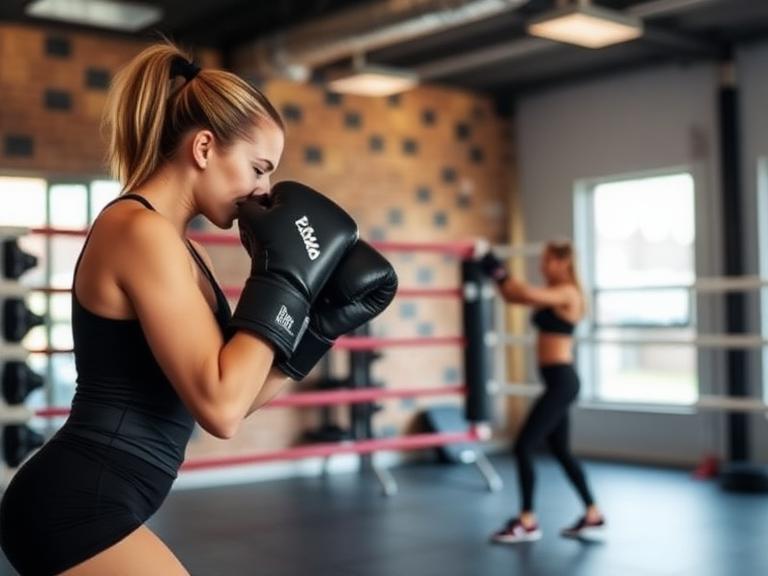
More women are walking into boxing gyms than ever before, and the reasons go well beyond fitness trends into confidence, community, and representation.
For a long time, combat sports gyms had a reputation, fairly or not, as male-dominated spaces that women had to push their way into rather than spaces built to welcome them. That reputation has been shifting steadily, and a growing number of women are actively choosing a dedicated women’s boxing Toronto program over a traditional gym membership, not as a niche alternative but as their primary form of regular exercise. Understanding why says as much about what women want from fitness as it does about boxing itself.
Representation Changes Who Feels Welcome
Visibility matters more than fitness marketing usually accounts for. When women see other women training seriously, competing, and coaching in a space, it changes the calculation of whether that space is “for them” before they ever walk through the door. Gyms that have built genuinely mixed-gender training cultures, rather than treating women as an afterthought bolted onto a male-dominated program, tend to see meaningfully higher retention among their female members, simply because new students can see themselves succeeding there from day one.
This effect compounds over time in ways that are easy to underestimate from the outside. A gym with two or three visible, respected female coaches sends an entirely different signal to a prospective new member than one where women are consistently in supporting or beginner roles only. Word of mouth among women considering trying the sport for the first time tends to travel through exactly these observations, whether a given gym is described as “actually good for women” or merely “technically open to them,” and that reputation, once established in either direction, tends to be sticky within a local training community.
The Confidence Case Is Different From the Marketing Cliché
“Boxing builds confidence” gets used as a generic marketing line often enough that it’s worth being specific about what actually changes. It isn’t vague self-esteem; it’s a concrete, physical sense of capability that develops from measurable progress, landing a clean combination that used to feel impossible, holding a stronger guard, or simply realizing your own physical strength has increased in ways you can feel in everyday life. That kind of embodied, physically demonstrated confidence tends to be more durable than confidence built purely through affirmation, because it’s backed by direct personal evidence rather than external praise.
This distinction matters because it explains why the confidence gained from combat sports training often carries over into completely unrelated areas of life, workplace assertiveness, willingness to try new challenges, general physical presence, in ways that a purely externally validated form of confidence tends not to. Once someone has directly experienced their own capability changing over months of consistent training, that evidence is difficult to talk themselves out of, even on a bad day.
Self-Defense Is Part of the Draw, But Rarely the Whole Story
Self-defense is a commonly cited reason women start training, and it’s a legitimate one, but coaches who work with a lot of female students consistently report that it’s rarely what keeps someone training long term. The self-defense skill development happens almost as a byproduct of training that women stay for other reasons: the fitness results, the community, the sense of accomplishment, and often simply because the training itself becomes genuinely enjoyable once the early learning curve passes.
This pattern shows up consistently enough that experienced coaches often stop leading with the self-defense pitch entirely when talking to prospective female students, since it tends to undersell what actually keeps people coming back. Someone who signs up specifically for self-defense skills often discovers, a few months in, that the fitness transformation and the training community have become the bigger draw, with the practical self-defense competence sitting quietly in the background as a genuine but secondary benefit.
| What draws women in initially | What actually keeps them training |
| Self-defense skill development | Visible fitness and strength progress |
| Curiosity about the sport | Community and training partners |
| A specific fitness goal | The skill-building process itself |
| A friend’s recommendation | A sense of accomplishment and capability |
The Physical Case Holds Up on Its Own Merits
Setting the social and psychological factors aside, boxing training is also simply an effective fitness format for building strength, cardiovascular capacity, and coordination in a single session. Research measuring the physiological demands of round-based combat-sport training has found substantial engagement of both aerobic and anaerobic energy systems, producing a combined conditioning effect that’s difficult to replicate with a single-modality workout like steady-state cardio alone.
For women specifically, this combined demand tends to be an appealing alternative to fitness spaces built almost entirely around a narrower aesthetic, weight-loss-focused framing. A round-based training session builds visible strength and power alongside cardiovascular capacity, which shifts the framing away from a purely appearance-based goal and toward a functional, capability-based one, a distinction that a growing number of women training today explicitly say they prefer.
Choosing Boxing Over Aesthetic-Focused Fitness Spaces
A meaningful part of this shift is a quiet rejection of fitness marketing built almost entirely around appearance. Many women who eventually land on boxing describe trying several more conventionally marketed fitness options first, only to find that a training format built around visible skill and strength, rather than around a specific body-image outcome, felt like a genuinely different and more sustainable relationship with exercise. That reframing, from “changing how I look” to “seeing what my body can actually do”, tends to produce far more durable long-term motivation than appearance-focused goals typically do.
What a Genuinely Welcoming Program Looks Like
Not every gym that accepts female members has actually built a culture that serves them well. A few signs distinguish a program that’s genuinely set up for women from one that just tolerates their presence:
- Visible female coaches or senior students, not just a token presence in marketing materials
- Class times and formats that account for a range of comfort levels, especially for complete beginners
- A culture that treats women’s training seriously, rather than as a lighter or secondary version of men’s classes
- Clear, enforced standards around respectful training partner conduct for everyone in the gym, applied consistently regardless of who is involved
A Realistic First Few Months
Women considering a first class sometimes worry the environment will be intimidating from day one. In a well-run beginner program, the actual experience looks different:
- The first few weeks focus almost entirely on fundamentals: stance, guard, basic strikes, drilled at a pace appropriate for complete beginners
- Partner drills are introduced gradually and are typically supervised closely by a coach
- Sparring, when it’s offered at all to beginners, is optional and comes much later, usually only for students who specifically want it
The Community Aspect Often Surprises New Members Most
Women who try a class expecting a purely individual fitness pursuit are often surprised by how social the training environment turns out to be. Partner drills mean training happens in pairs and small groups almost by default, and a consistent group of training partners tends to form organically within the first couple of months of regular attendance. For many women, that community becomes one of the more unexpectedly valuable parts of training, a low-pressure social structure built around a shared activity rather than around any particular social scene or existing friend group.
This matters especially for women who have moved to a new city or gone through a major life transition, since it offers a genuine, structured way to build new social connections that doesn’t depend on already knowing people. A regular training schedule with the same group of people creates exactly the kind of low-stakes, recurring social contact that’s otherwise surprisingly hard to manufacture as an adult.
Common Questions
Do women need any athletic background to start boxing? No. Reputable beginner programs are built for people starting from zero prior experience, and a meaningful share of long-term female members had no athletic background before their first class.
Is boxing training safe for women specifically? Yes, when the gym enforces proper supervision, appropriate contact levels for beginners, and a genuinely respectful training culture. These standards matter more than gender-specific programming on their own.
How long before someone feels confident in a mixed-level class? Most women report feeling comfortable within the first month or two of consistent training, once basic technique starts to feel less foreign and the gym’s regular faces become familiar.
Do women need to compete to get real benefits from training? No. The large majority of women who train boxing seriously never compete, and the fitness, confidence, and community benefits are fully available to purely recreational students who have no interest whatsoever in ever stepping into a competitive ring.
Is it normal to feel intimidated before a first class? Very normal, and most women who have been training for a while report feeling exactly the same way before their own first class. That initial nervousness rarely reflects how the gym’s actual training culture turns out to feel once someone has attended a few sessions and gotten to know the coaches and other regular students.
References
- PubMed, “Physiological Responses and Energy Cost During a Simulation of a Muay Thai Boxing Match” — https://pubmed.ncbi.nlm.nih.gov/19370044/
- 2. Harvard Health Publishing, “Interval Training for a Stronger Heart” — https://www.health.harvard.edu/exercise-and-fitness/interval-training-for-a-stronger-heart
- 3. American Council on Exercise, “Training Mixed Martial Arts Athletes Using the ACE Integrated Fitness Model” — https://contentcdn.eacefitness.com/cp/pdfs/CertifiedNews/AprMay10Cert.pdf
