


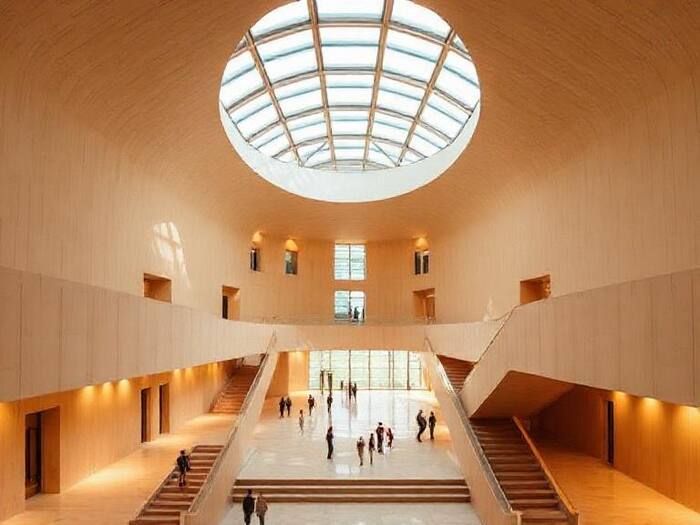
Architecture is more than the composition of walls, materials, and visible form. It acts like an encoded system of quiet instructions-subtle cues encoded in structure, light, rhythm, and void. Each building becomes an instrument that influences the way people drift, pause, notice, recall, and return. A city is not simply a network of streets; it’s a layered atlas of spatial reactions. Where the past century sought spectacle, the present moment leans toward cognitive clarity. Buildings now attempt to orchestrate states of mind as deliberately as they define physical boundaries.
Architecture’s influence begins before a person enters a space. Approaches, thresholds, and lines of sight form the psychological prelude to the built environment. A narrow walkway that widens just before the entry does not simply “look interesting”; it primes the visitor for openness. A tall vertical façade with minimal articulation is not only an aesthetic choice; it is a signal of authority, discipline or restraint. People interpret these patterns instinctively, well before they articulate any preference.
Inside, the spatial script continues. Human perception is strongly responsive to contrast between light and shadow, between enclosure and release. A building that reveals its central space too early diminishes its sense of discovery; one that reveals nothing becomes oppressive. The dance between anticipation and revelation is what differentiates a memorable architectural experience from an ordinary one. Even minor gestures-like the angle of a stair landing or the curvature of a corridor-affect emotional pacing.
Unusual Influences on Architectural Atmosphere
Sometimes, the atmosphere of a building is defined by those qualities that evade regular classification. The acoustic textures, for instance, may be as powerful in shaping memory as is the form in view. A soft reverberation in the library may invoke seriousness; a muted floor in a gallery, a sense of time suspended. Temperature differentials, even subtle, affect perception of distance: cooler spaces feel more elongated, warmer spaces feel nearer. This multidimensional interplay gives architecture its quiet ability to choreograph life without overt instruction.
Elements That Modify Human Locomotion:
1. Spatial Cues That Guide Circulation
- Transitional compression: narrow-wide-narrow spatial rhythms
- Light-direction corridors: paths that show destination through lighting
- Textural shifts on flooring that announce subtle boundaries
- Height modulation to introduce hierarchy
- Peripheral voids that nudge movement in specific arcs
- Elements That Slow Down or Halt Occupants
2. Vertical interruptions such as partial walls near nodes
- Niches, intentionally designed for micro-dwelling moments.
- Elevated platforms that alter line-of-sight
- Threshold pockets that create psychological buffers
- Overhead lowering to induce reflective stillness
Architectural memory and internal mapping of the body
People don’t remember buildings the same way they do images; they remember sequences, sensory impressions, and transitions. The brain creates internal maps from how the body navigates space. The corners where one turned, the stair that changed tempo, the window where light fell in a precise pattern-these become the markers of memory. Architecture becomes unforgettable not because it is visually extravagant but because it offers a series of well-timed spatial events.
The relationship between body and space is key to architectural design today. Neuroscience continues to establish how architecture can reinforce calmness, sharpen attention, or even alter emotional registers. These ideas are increasingly leveraged by designers shaping educational environments, health care settings, and workplaces. The goal is not manipulation but alignment: creating structures that resonate with human cognition.
The Architect as Spatial Composer
Designers are not just object makers anymore. They work more like composers, orchestrating sequences of experiential notes. A building’s form may satisfy structural logic, but its soul materializes from intangible orchestrations-shadows that migrate across the day, materials that age into new chromatic states, or circulation paths that bend gently to accommodate natural walking arcs.
What differentiates the architecture of this epoch is its refusal to rely on either historical pattern or predictable modernist repetition. The architects combine intuition, environmental analysis, and computational experimentation. The result is a form of architecture that doesn’t feel hyper-digital or traditionally nostalgic. It’s a hybrid practice in which space is treated as a dynamic field rather than a static enclosure.
Sites of Collective Experience
Public architecture is central to the formation of collective memory. The spatial decisions inherent in plazas, museums, transit hubs, and civic halls define how communities engage with one another. A well-designed public space creates opportunities for interaction without forcing it, enables movement without chaos, and gives aesthetic presence without overwhelming spectacle. When these places succeed, they anchor urban identity.
Conversely, poorly resolved public spaces create disorientation, inefficiency, or friction. The difference often lies in nuances rather than grand gestures: a misaligned seating cluster, poorly shaded area, or a circulation path that sets up unnecessary conflict between slow and fast users. Good architecture anticipates these micro-interactions before they happen.
A Forward-Looking Architecture
Hybrid environments will probably define the future of architecture: spaces that automatically respond to human needs but retain the tactile richness of traditional craftsmanship. Adaptive facades, sensory-driven lighting, and intelligent climate modulation will go hand in hand with stone, timber, and worked metal. The digital and the material will no longer be in opposition but rather will be partners in framing the atmosphere. The role of architecture is ultimately to create spatial conditions that help people live more attentively. In becoming more aware of how buildings shape us, we become at once more conscious participants in the environments we inhabit. The spaces we design now will influence how future generations walk, gather, imagine, and remember.
Read Also: Top 10 World’s Tallest Buildings
