


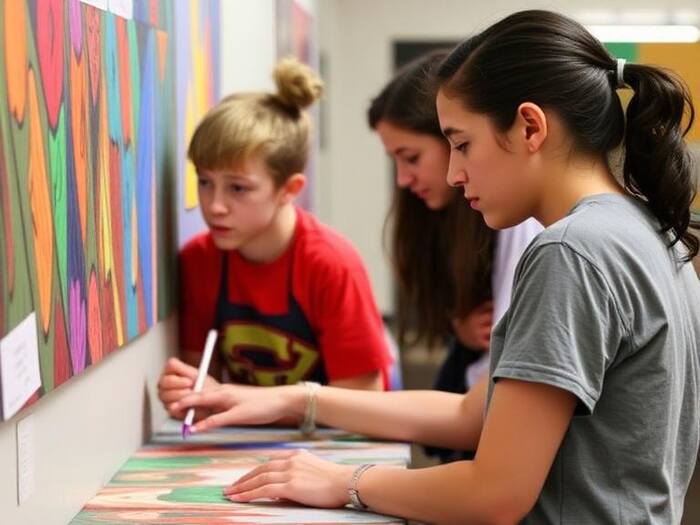
Many young scholars struggle to express their thoughts through words alone. Art class provides a vital space for these students to share ideas. Creative projects help bridge the gap between abstract concepts and solid forms. This environment fosters a sense of pride and focus in every learner. Teachers guide them through various tools to build confidence and skills. This article details the core lessons found in these creative courses.
Basic Elements of Visual Work
Students study lines, shapes, and textures to build a solid base. The junior high art curriculum covers how light affects the look of a surface. Teachers show how to mix colors to create specific moods or depth.
Art instructors introduce the concepts of space and form in three dimensions. Pupils learn to use shadows to make flat circles look like spheres. They practice how to balance a composition for a pleasant visual effect. These skills help them see the world with a much sharper eye.
Traditional Tools and Mediums
Paper, pencils, and charcoal serve as the primary tools for daily work. Students master the grip of a brush to apply paint with care. They explore how different surfaces react to water or oil-based products. Each tool teaches a lesson about patience and physical control over materials.
Wood, clay, and wire also play a role in the studio. Hand-eye coordination improves as they mold soft clay into sturdy pots. They use glue and tape to construct complex models from simple scraps. These tactile tasks strengthen the brain and the hands at the same time.
Historical Styles and Culture
History lessons reveal how past masters used symbols to tell a story. The junior high art curriculum explores various movements from the past few centuries. Students look at ancient artifacts to grasp the roots of modern craft. They discover how culture dictates the choice of colors and patterns used.
Scholars compare different eras to see how techniques change over time. They learn to identify the work of famous painters and sculptors quickly. This knowledge builds a deeper respect for the efforts of previous creators. Art history turns a blank canvas into a bridge to the past.
Creative Process and Plan
Preparation starts with a simple sketch or a basic rough draft. Students learn that a good plan leads to a better final piece. They track their progress in a book to see how ideas grow. This habit builds a strong work ethic that applies to other classes.
Instructors teach the value of a slow and steady work pace. Students fix errors and refine details until the work looks complete. They learn to accept feedback from peers to improve their own vision. Group critiques build a sense of community and shared goals in class.
Artistic Voice and Choice
Freedom of choice allows a student to pick themes that matter. They select specific colors to show how they feel about a topic. This personal touch makes every project unique and special to the creator. Self-expression helps them understand their own place in the broad world.
The classroom turns into a lab for new and bold experiments. Students test how two different textures look when placed side by side. They find joy in the act of creation without fear of mistakes. Confidence grows as they see their own progress over many weeks of work.
Visual Literacy and View
Visual literacy helps a student decode the messages in the media. They learn how colors in an ad can change a person’s mood. Critical thought becomes a tool to parse the world of visual data. This skill makes them smarter consumers of images and digital media.
Analysis of work professionalism sharpens the ability to judge quality and intent. Students describe what they see with clear and precise technical terms. They discuss the balance and contrast of a piece with great detail. Art education builds a mind that seeks truth and beauty everywhere.
Creative education builds vital skills that last a lifetime. Beyond simple sketches, students develop a sharp eye for detail and a steady hand for complex tasks. This path fosters a deep respect for culture and human effort. Encourage your student to explore these lessons to unlock a new way to see and interact with the world around them. Every brush stroke builds a more confident and capable mind.
